
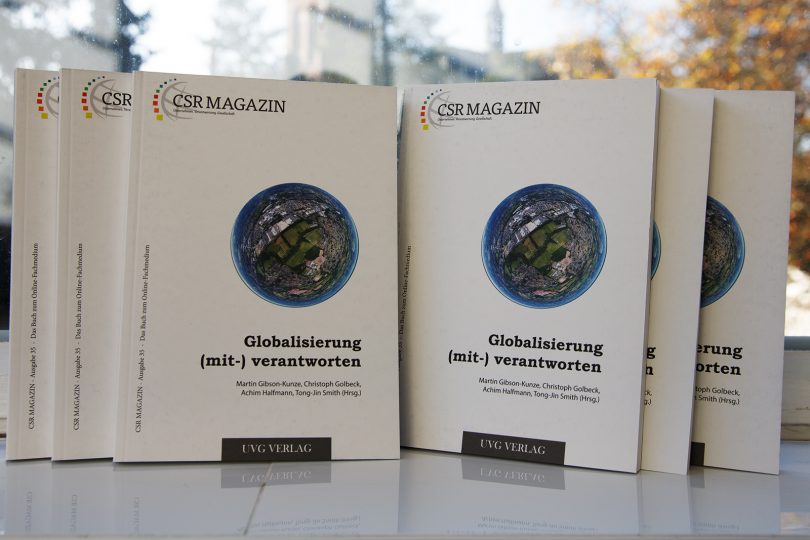
Berlin (csr-news) – Das 35. CSR MAGAZIN liegt jetzt auch in der Printausgabe vor – mit einigen Neuerungen: Mit dieser Ausgabe bieten wir Ihnen einen um 60 Seiten erweiterten Magazinumfang. Lesen Sie mehr wissenschaftliche Hintergrundinformationen und zugleich mehr Berichte aus der Praxis.
Fachtexte, Reportagen und Interviews wechseln sich im Magazin. Neben den Texten erfahrener Journalisten und Autoren bieten wir wieder einen Text von Nachwuchsjournalisten, um unterschiedlichen Generationen eine Stimme zu geben. Ein hochauflösendes PDF und das EPUB des CSR MAGAZIN stehen zum Download bereit. Die Printausgabe folgt im Oktober.
Unter dem Titel “Globalisierung (mit-)verantworten” fragen wir danach, wie Unternehmen und Nachhaltigkeitsakteure die großen gesellschaftliche Entwicklungen mitgestalten können.
Das lesen Sie in diesem 35. CSR MAGAZIN:
Die einzelnen Beiträge der Magazinausgabe
stellen wir Ihnen frei lesbar zur Verfügung
(Open Access).
Jump-start the pursuit for sustainable change with personal ownership
“Small Actions, Big Difference”
By CB Bhattacharya
Digitale Spaltung gefährdet soziale Nachhaltigkeit
Globalisierung als Chance für die ganze Gesellschaft
Von Thomas Osburg
Bildung für verantwortungsvolle Globalisierung
Mit Kollaboration und Interkulturalität Nationalismen überwinden
Von Tong-Jin Smith
Impulse aus dem CSR NEWS-Netzwerk
ESCP Business School kooperiert mit dem Umweltprogramm der Vereinten Nationen
Von ESCP Business School in Berlin
Die Gemeinwohl-Ökonomie und ihr Berichtsformat
Verantwortung dokumentieren und Wirtschaft umgestalten
Von Achim Halfmann
Die Dynamik in der Entwicklung von Arbeitsmodellen
Alles wird besser im Home Office?
Von Natalie Weirich
Neues Mindset für nachhaltigen Wandel
Resilient durch Nachhaltigkeit?
Von Philipp Dahl
Arbeitsmarktintegration von Geflüchteten
Befähigung und Verantwortung auf mehreren Ebenen
Von Matthias Schmidt
Gemeinschafts- und mitarbeiterzentrierte Verantwortung
Die betriebliche Integration von Geflüchteten
Von Sebastian Koos und Anna Apostolidou
Unternehmen integrieren Geflüchtete
2.500 Unternehmen für die Integration
Bill Liederwald im Interview
Mitarbeitermangel und Diversität
Perspektive Pflegeberuf
Fatima Meyer-Hetling und Andrea Kuckert-Wöstheinrich im Interview
Impulse aus dem CSR NEWS-Netzwerk
„Unternehmens-Spiritualität“ vollendet Ethik-Kodex
Von Jürgen Kutsch
Impulse aus dem CSR NEWS-Netzwerk
Klimaschutz braucht Akzeptanz – Das Bantleon Forum
Von Hermann Bantleon GmbH
Impulse aus dem CSR NEWS-Netzwerk
Funktionsweise und Zusatznutzen von Klimaschutzprojekten
Von ClimatePartner
Artenverlust bedroht Geschäftsmodelle
Biodiversität ins Wirtschaften und Finanzieren integrieren
Von Susanne Bergius
Neustart nach der Krise
„Coronomics“: ESG ist ein Eckpfeiler
Von Klaus Rainer Kirchhoff
Nachhaltigkeitsengagement in der Schifffahrt
Umsteuern braucht Zeit
Das Interview mit Anders Grønning
Komplexität und Nachhaltigkeit managen
Digitale Ansätze für eine transparente Lieferkette
Von Frank Ebinger
Das Sorgfaltspflichtengesetz
Chance zum Dialog auf Augenhöhe
Ein Perspektivwechsel von Carolin Friedrich
Schulungen in der Lieferkette via Tablet
Digitale Zugänge in Corona-Zeiten
Sonja Westphal im Interview
Sicherheitsgesetz in Hongkong
Wie Unternehmen auf die Bedrohung der Freiheit reagieren
Von Achim Halfmann
CSR Risiko-Check blickt auf Menschenrechte und Ökologie
Risiken in der Lieferkette erkennen
Von Caroline Zamor
Menschenrechtsschutz in Lieferketten
Der Smart Mix
Von Holger Hembach
Menschenrechtliche Sorgfaltspflicht in der Unternehmenspraxis
Der weite Weg von der Einsicht zur robusten Strategie
Von Theresa Quiachon und Laura Much
Sustainable Development Goals und Unternehmensverantwortung
SDGs entfalten eine enorme Zugkraft
Von Christoph Schank
Impulse aus dem CSR NEWS-Netzwerk
SDG-Wegweiser für Mittelständler
Von akzente
Ein Faktencheck bei nachhaltigen Tourismus-Anbietern
Unternehmen auf der Seite von Tieren, Natur und Klima?
Von Katharina Hartlieb, Magdalena Bortel und Manuel Kowol
„Die Würde des Menschen ist (un)antastbar“
NGOs und Zivilgesellschaft in der vernetzten Welt
Von Esther Heidbüchel und Thomas Schiffelmann
Noch nicht im Mainstream angekommen
Die ökologische Landwirtschaft wächst stetig
Christian Herzig im Interview
Genossenschaften für ein gemeinschaftliches Wirtschaften
Die Solidarische Landwirtschaft
Das Interview mit Stephanie Wild
Nachhaltige Mode
Die Rolle von Accessoires
Von Katharina Klug
Herausforderungen in der textilen Lieferkette
„Unsere Sourcingmaßnahme heißt Konzentration“
Mathias Diestelmann und Rabea Schafrick im Interview
Impulse aus dem CSR NEWS-Netzwerk
Discounter setzen auf Nachhaltigkeit
Von KiK Textilien und Non-Food
Impulse aus dem CSR NEWS-Netzwerk
„Dibella up“ schließt den Kreis
Von Dibella
CSR und Plastikvermeidung bei cosnova
„Beim Verzicht auf Mikroplastik muss die Produktleistung gleichbleiben“
Silvia Steinert und Maximilian Peters im Interview
Plastics for Change
„Brands wollen die Story und brauchen Qualität“
Myriam Shankar im Interview
Das #ForumRezyklat
„Wir denken Wirtschaft noch zu sehr als Fließband“
Sebastian Bayer im Interview
Hoher Anspruch bei Qualität und Hygiene
Rewe bietet erste unverpackte Produkte
Pia Schnück im Interview
Ein Startup sammelt wildes Plastik
Mit dem Wildbag Impact erzielen
Dieter Gottschalk im Interview
Alternativen für Sport- und Outdoorkleidung
Mikroplastik aus Textilien belastet die Umwelt
Maike Rabe im Interview
Plastikmüllvermeidung und die Verbraucher
Zero Waste: Weniger ist im Meer
Von Daniel Silberhorn
Unternehmer für ihr Dorf
Firmenengagement im ländlichen Brandenburg
Von Achim Halfmann
Das erwartet Sie in den nächsten Ausgaben.
CSR MAGAZIN 2021: Die große Transformation
Beteiligen Sie sich mit Ihren Fragen, Erfahrungen und Ihrer Expertise!
Wir freuen uns auf Ihre Rückmeldungen und Erfahrungen! Senden Sie gerne Ihr Feedback an redaktion@csr-news.net.